Test your knowledge of the JN0-105 exam dumps with TopExamCollection Junos, Associate (JNCIA-Junos) (JN0-105) practice questions. The software is designed to help with Junos, Associate (JNCIA-Junos) (JN0-105) exam dumps preparation. Junos, Associate (JNCIA-Junos) (JN0-105) practice test software can be used on devices that range from mobile devices to desktop computers. We provide the Junos, Associate (JNCIA-Junos) (JN0-105) exam questions in a variety of formats, including a web-based practice test, desktop practice exam software, and downloadable PDF files.
| Topic | Details |
|---|---|
| Topic 1 |
|
| Topic 2 |
|
| Topic 3 |
|
| Topic 4 |
|
| Topic 5 |
|
| Topic 6 |
|
>> Reliable JN0-105 Test Bootcamp <<
We provide 24-hours online customer service which replies the client’s questions and doubts about our JN0-105 training quiz and solve their problems. Our professional personnel provide long-distance assistance online. Our expert team will check the update JN0-105 learning prep and will send the update version automatically to the clients. So the clients can enjoy the convenience of our wonderful service and the benefits brought by our superior JN0-105 guide materials.
NEW QUESTION # 56
A network administrator is attempting to route traffic on a Juniper switch to one of three different VLANs:
Prod, Test, and Dev. Each VLAN has been assigned a numerical value.
In this scenario, what are these numerical values called?
Answer: A
Explanation:
In the context of VLANs (Virtual Local Area Networks) on a Juniper switch, the numerical values assigned to each VLAN, such as those for Prod, Test, and Dev, are known as VLAN tags. These tags are part of the 802.1 Q VLAN standard, which allows multiple VLANs to coexist on a single physical network. Each tag uniquely identifies the VLAN to which a frame belongs, enabling the switch to segregate and manage traffic based on VLAN membership. This tagging mechanism allows for efficient traffic separation and management, ensuring that devices within one VLAN do not receive traffic intended for another, thus maintaining network security and efficiency.
NEW QUESTION # 57
Which two statements are correct about a Routing Engine? (Choose two.)
Answer: A,D
Explanation:
The Routing Engine (RE) in Juniper Networks devices plays a pivotal role in the control plane, handling tasks that are critical for the operation and management of the network. One of its key functions is processing management traffic, which includes user commands, system configuration, and monitoring operations. The RE also maintains routing tables, which are essential for network routing decisions. These tables contain network topology information and routing paths, which the RE uses to update the Packet Forwarding Engine (PFE) so that it can forward packets appropriately. The RE does not forward transit traffic or process Class of Service (CoS) marked traffic, as these tasks are handled by the PFE.
NEW QUESTION # 58
Which three benefits occur when operating an interior gateway protocol (IGP) in an autonomous system (AS)?
(Choose three.)
Answer: A,B,E
Explanation:
Operating an Interior Gateway Protocol (IGP) within an Autonomous System (AS) provides several benefits, including determining the optimal paths for data transmission (B), reacting quickly to network changes (D), and learning all about the subnets and best paths within the network (E). IGPs are designed to manage routing within a single AS efficiently, adapting to changes and ensuring data is routed through the best available paths.
NEW QUESTION # 59
Which command displays all IPv6 routes in the default routing instance?
Answer: C
Explanation:
In Junos OS, the command to display IPv6 routes in the default routing instance isshow route table inet6.0.
The routing tableinet6.0specifically holds IPv6 routes. The commandshow route table inet.0is used for IPv4 routes, andinet6.1orinet.l(assuminginet.lis a typo forinet.1) are not standard Junos routing tables for displaying IPv6 routes in the default routing instance.
NEW QUESTION # 60
Click the Exhibit button.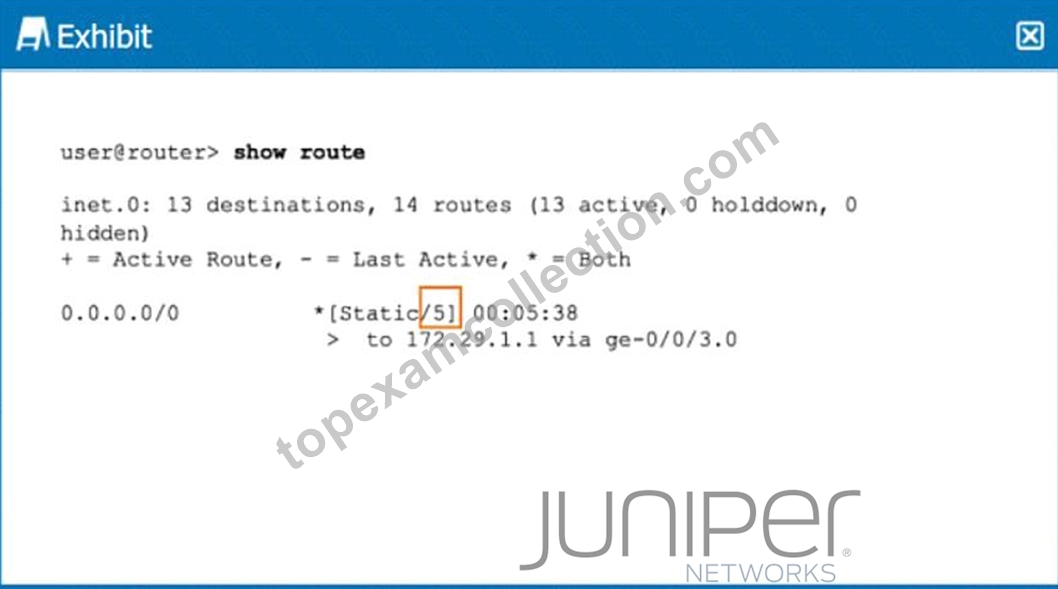
Referring the exhibit, what does the highlighted number indicate?
Answer: C
Explanation:
In the exhibit shown, the highlighted number next to the route type (Static) within the square brackets indicates the route preference, also known as the administrative distance. In Junos, the route preference is a value that determines the priority of the route source. Lower numbers indicate a higher priority when the routing table is being calculated. The route preference is used to select the best route when multiple paths to the same destination exist from different routing sources. The number 5 is unusually low for a static route by default, suggesting it has been manually configured to override other route types.
NEW QUESTION # 61
......
TopExamCollection aims to assist its clients in making them capable of passing the Juniper JN0-105 certification exam with flying colors. It fulfills its mission by giving them an entirely free Junos, Associate (JNCIA-Junos) (JN0-105) demo of the dumps. Thus, this demonstration will enable them to scrutinize the quality of the Juniper JN0-105 study material.
Test JN0-105 Valid: https://www.topexamcollection.com/JN0-105-vce-collection.html